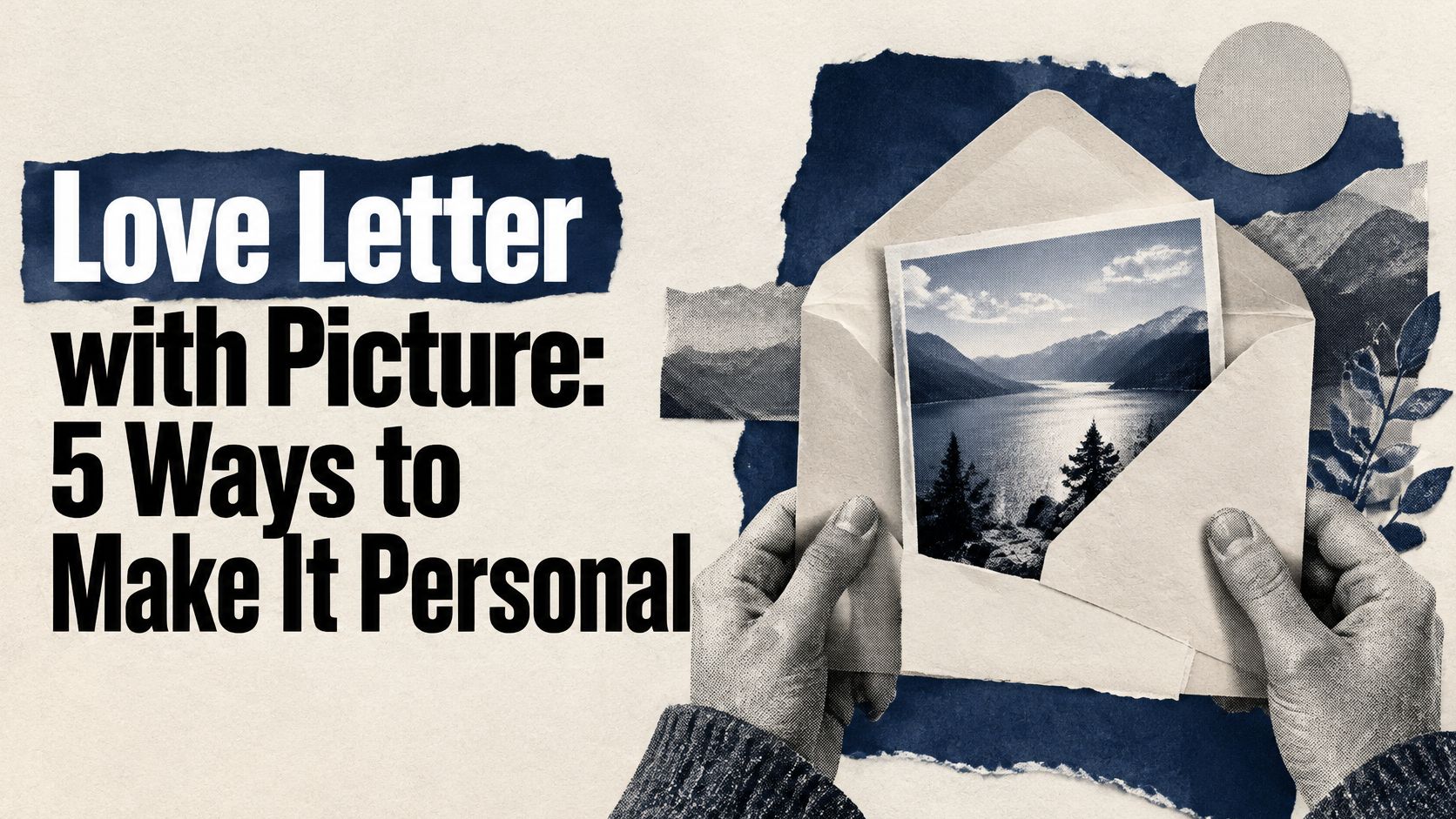
You have one photograph that keeps pulling you back. It's the two of you on a wet afternoon in a city whose name you still mispronounce, or a kitchen at 1 a.m., or the exact spot where something funny happened that only the two of you understand. You've started the letter that should go with it. Then you stall on a practical question: does the picture go inside the folded page, behind it, or in an envelope of its own?
That question matters more than it sounds. A photograph doesn't illustrate a love letter. It does a different job. The words explain what a moment meant, and the picture triggers the remembering. Pair them well and the recipient feels the day come back. Pair them carelessly and you've sent a pleasant image with pleasant words attached, which is roughly what a shop-bought card does.
This guide treats a love letter with picture as two connected pieces of one message. It covers how to choose the photo, how to caption it so it lands, how to order several photos so they tell a story, and two things most love-letter advice skips entirely: consent and accessibility. Both decide whether the person receiving it feels closer to you or exposed.
Table of Contents
- Five Ways to Pair a Photo With a Love Letter
- Choosing the Photograph That Carries the Memory
- Writing Captions That Make the Photo Specific
- Ordering Photos and Words in One Sequence
- Keeping It Personal Without Overexposing Anyone
- Making the Pairing Readable for Every Recipient
- Picking the Format and Sending It
Five Ways to Pair a Photo With a Love Letter
In 1934, during their courtship, Lyndon B. Johnson and Claudia Alta "Lady Bird" Taylor exchanged more than 90 letters in under three months, roughly one a day and sometimes two, traveling between Washington, D.C., and Karnack, Texas. Photographs and books went in alongside the handwriting. Distance drove the frequency, and the physical inserts carried what sentences alone could not.
The pairing problem has not changed. A sender today has one great photo from a road trip, a half-written letter on the desk, and the same question: where does the picture go? There is no single correct answer, only formats that suit different amounts of material.
| Format | How the photo and letter sit together | Best for | Rough effort |
|---|---|---|---|
| Photo tucked behind a handwritten letter | Photo sits behind the folded page and is found when the letter is unfolded | Short notes about one shared memory | Low, about 30 minutes |
| Photo postcard | Photo on the front, message on the back | Several photos, each with its own note | Medium, each card printed and written |
| Photo letterhead | Photo printed across the top of the page | Anniversaries with one clear image | Low to medium |
| Photo strip in a folder | Prints with captions in order, held by a card | A long history told as a timeline | Medium to high |
| Digital envelope | Letter, photos and video sealed in one link | Long distance, recipient far away | Low, about five minutes |
Choose by how much the photo has to carry. One photo supports a short letter, where the image triggers the memory and the words explain what it meant. Several photos spanning years need a sequence, because a pile of images without order reads as an album rather than a message. When the recipient is far away, or a video belongs in the same delivery, the digital option wins on logistics: a digital envelope holds the letter, photos presented as postcards and a video in one link, opens on the recipient's phone without an app, and can stay sealed with a countdown until a day and time set in their time zone. The same approach suits an ordinary Tuesday or Valentine's Day.
The lesson from 1934 holds. The words set the emotional context, and the photograph adds what words cannot carry.
Choosing the Photograph That Carries the Memory
Two people can scroll the same camera roll and stop at different photos. You pause on the one where the light was kind. They pause on the grainy shot from the night the train never came. For a love letter, their stop is the right one.
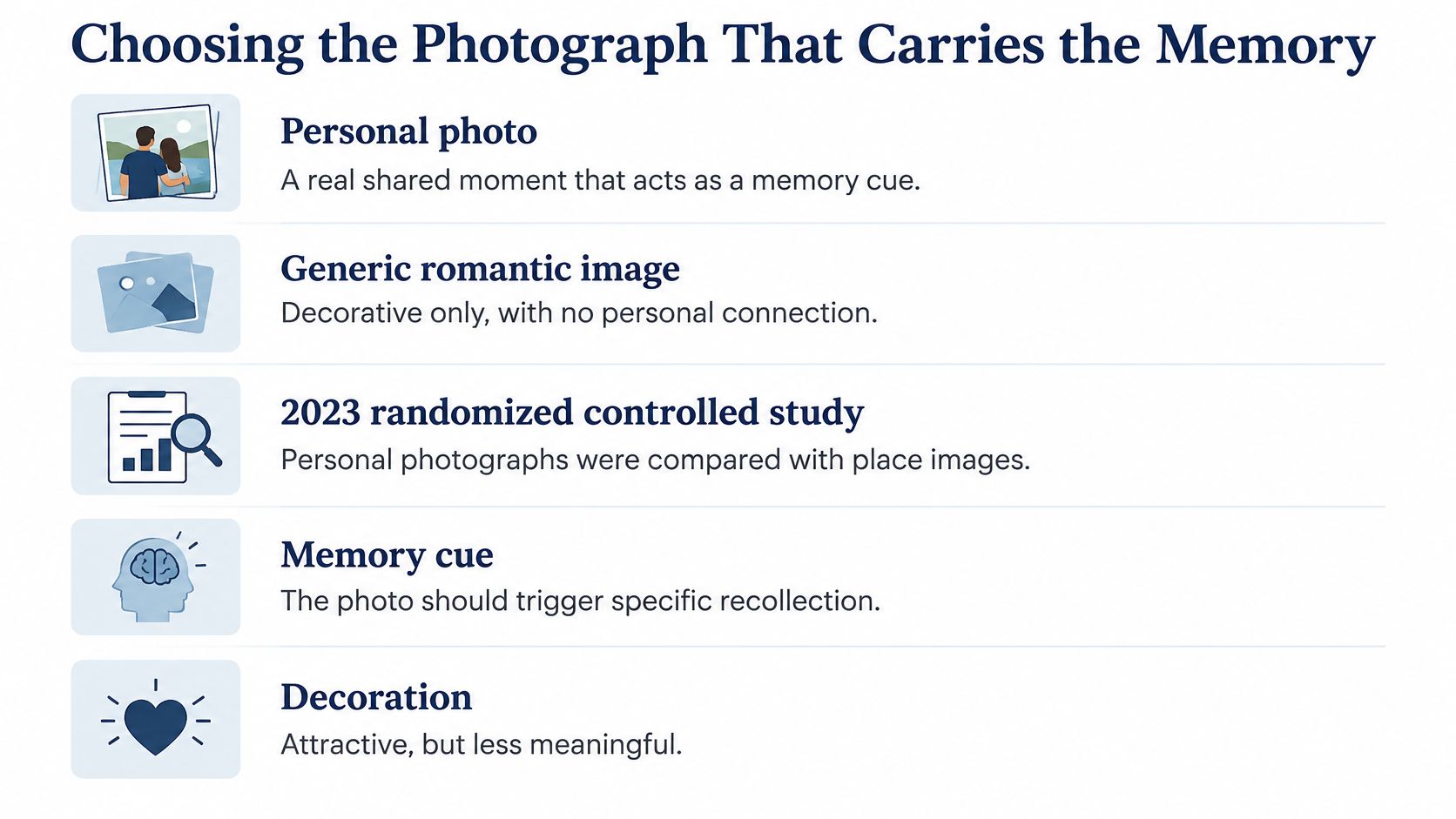
A photograph in a love letter has a job: it retrieves a memory. A 2023 randomized controlled study compared personal photographs with place images and standardized emotional images, and found that all three types raised positive mood, but personal photographs produced the strongest reduction in negative affect among younger adults, per the study in Current Psychology. The mechanism is retrieval. An image tied to a specific shared event reopens a detailed, emotionally charged recollection, and the recipient reads your words through it.
That is why a picture showing both of you, or a place you both know, beats a beautiful generic scene. The image does not need to impress anyone. It needs to hand the recipient a door back into one exact moment, ideally before they have read a single line.
Five questions to ask before you commit
- Does it show both of you, or a place you share? A stranger's silhouette on a beach does nothing a stock image couldn't do.
- Is it tied to a specific date or event? A birthday, a move, a bad train journey, a Tuesday. The more pinned-down the moment, the sharper the recall.
- Is it sharp and well lit enough to see faces and details? A blurry photo gives the recipient nothing to re-enter, unless the blur is part of the story you are telling.
- Would they recognize the moment at a glance? If they need you to explain which trip it was, the cue is too weak.
- Is it the one they would reread, not the one you like best? Your favourite shot and their formative memory aren't always the same photo.
Practical rule: if a photo could belong to any couple, it belongs in a frame, not in a love letter.
The photo retrieves the moment. The letter tells them what the moment meant, and why you are still carrying it.
Writing Captions That Make the Photo Specific
A caption is the doorway into the picture. Without one, the recipient sees an image and guesses. With one, they walk into the afternoon.
Use four steps, in this order.
Name the place and the date, even roughly. "The rainy Tuesday in Lisbon" does more than "our trip." Precision is what makes a memory retrievable and repeatable.
Describe what was happening in one line. Who was laughing, what went wrong, what you were both looking at. One line. Not a paragraph of scene-setting.
Say what the moment means to you now. One honest sentence in the present tense. "I still think about that bench" is better than "we had such a lovely time."
Point to something shared next. A trip you've planned, a question you want answered, a promise. It turns a memory into an invitation.
Here's the difference in practice. A weak caption reads: "Remember this? Love you." The photo is left carrying all the weight, and it can't.
A caption that works reads: "The rainy Tuesday in Lisbon when we missed the tram and ate pastéis on a wall. Still my favourite mistake, and I want the next one with you."
The slip nearly everyone makes
The sweet line with no detail is the common failure. It feels affectionate to write, and it gives the recipient nothing to hold. Affection without specificity is a mood, and a mood fades by the next scroll.
Keep the caption to two or three sentences. That's a practical limit, not an aesthetic one: a postcard back and a phone screen both run out of room, and a caption that needs scrolling gets skipped.
If the recipient couldn't place the moment from the caption alone, add one concrete detail. A street name, a meal, a song, the thing you both still quote.
Once you have three or four well-captioned photos, the next problem is order.
Ordering Photos and Words in One Sequence
A sequence of photos isn't a gallery. Each image should do one job the others don't, the way each line of a letter earns its place.
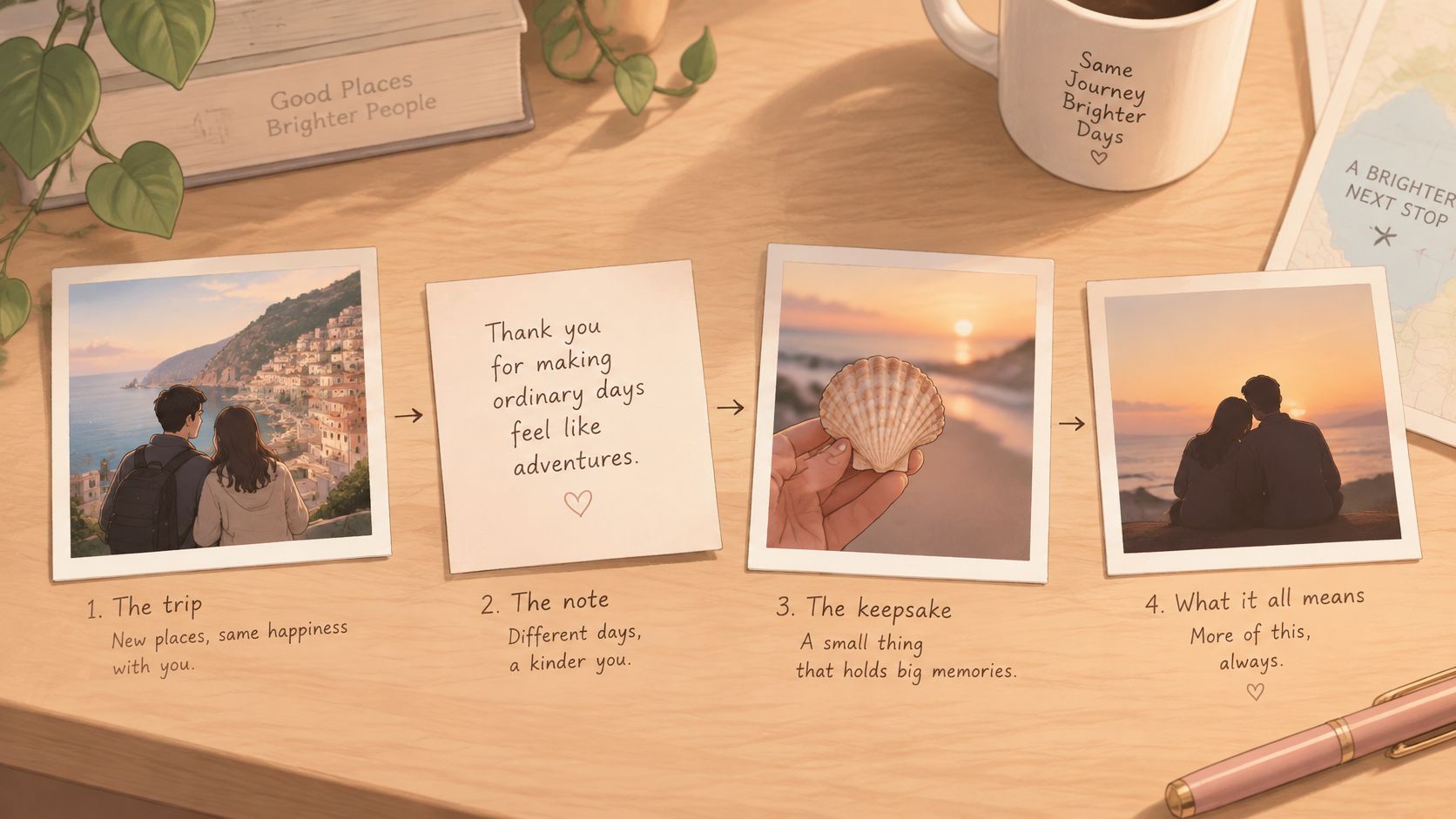
Order matters because each photo works as a memory cue and the words beside it supply the explanation. A systematic review of autobiographical-photograph interventions in older adults found associations with improved well-being, quality of life, personal identity and cognitive functioning, per the review in Psychological Research. The same review notes that photographed events can receive higher positivity ratings, but that positivity fades at a different rate over time, so adding more exposures does not automatically add more warmth.
That has a practical consequence. Three to five high-relevance images beat fifteen decent ones. Arrange them the way the memory unfolded: where you started, one turning point, the relationship now, and what you intend next. Each image should have adequate contrast, an identifiable subject and a short text description.
Skip near-duplicates. Two frames from the same minute add weight to the envelope without adding a distinct memory.
Three orderings that work
- Letter first, then photos. The words set the context before the images arrive, which suits a reflective letter.
- Photos in sequence, letter last. The images build the story and the prose lands the feeling.
- Alternating photo and note. Suits a timeline of years, where each image needs its own short frame.
In a digital envelope, the sender adds the letter, photos, a video and the gift card, then seals the envelope and sets the day and time it opens in the recipient's time zone, with a countdown shown until then. Each envelope holds up to ten pieces in a chosen order, and that limit forces a useful decision: count the pieces, drop the weakest, then arrange what is left. If the letter is only for one person, you can also set a passphrase with a hint on the envelope.
If you'd rather build around postcards, this guide to sending a digital postcard explains how a single photo and message sit together on one card.
Keeping It Personal Without Overexposing Anyone
A photo of your partner isn't automatically romantic. It's romantic when they know it exists, they're happy for it to exist, and they keep some control over where it goes. Sender intent doesn't settle any of that.
An Australian Government eSafety survey found expectations split, and not in a tidy way. According to the eSafety survey on tech-based coercive control, 28.7% agreed that a partner insisting on checking how they look before sharing a photo is usually caring, while 30.1% agreed that expecting to photograph a partner without asking is reasonable, with that view higher among men than women at 36.8% versus 23.3%. Plenty of people think a candid shot is affection. Nearly as many think a check-in is care. Both groups are dating each other.
The five-point pre-send check
- Everyone identifiable has seen the photo and agreed to it. Including the friend in the background.
- It doesn't reveal a home address, a workplace, a school, or a street sign. Location is privacy, even in a romantic frame.
- It isn't intimate, and it wasn't taken without the subject knowing.
- You've warned the recipient about sensitive material in a separate message, so nothing tender lands in front of their colleagues or at a bad moment.
- You're ready to swap or remove a photo quickly if the person pictured changes their mind after seeing it.
A shared link gathers letters, photos, videos and gift-card material in one place, which is convenient right up until one careless image travels further than you meant. Until the recipient opens an envelope, you can sign in with the paid email and change its contents, and the link stays the same, so a mistake is fixable. If the envelope is only for one person, you can also set a passphrase with a hint, so a forwarded link stays sealed for anyone else. Stampgoose doesn't sell customers' data, letters, photos or the names of recipients, which matters when the content is this personal.
The honest test: would you be comfortable if the person in the photo opened it in front of their mother? If not, ask first.
Affectionate surprise and unwanted exposure look similar to the sender and completely different to the person pictured.
Making the Pairing Readable for Every Recipient
Most advice on a love letter with picture covers photo choice, wording and layout. Almost none covers how a blind, low-vision, deaf or neurodivergent recipient will experience the message. A highly visual envelope can shut someone out unless the emotional meaning also lives in text or audio.
The web-wide numbers are bleak. Roughly 13% to 14% of images lack an alt attribute, about 30% use an empty alt attribute, and approximately half of images have either empty alternative text or text shorter than ten characters, according to the HTTP Archive Web Almanac 2025 accessibility chapter. Video is worse: caption-track usage reached only 0.4% on desktop and 0.2% on mobile in 2025.
How to describe a photo affectionately
Describe who appears, their expression, the setting and the relationship context in one or two sentences. Skip "image of a couple." Write something like: "Us at the lake in Ohio, you laughing with a hand over your eyes, me squinting into the sun." That's a description someone can feel, not a label they have to translate.
Some checks worth running before you send:
- Decorative images may take an empty description. A border flourish or a background texture needs nothing.
- A meaningful photo needs a full description, especially if it's the whole point of the card.
- Readable typography and strong contrast help recipients with low vision and anyone reading on a phone in daylight.
- Any attached video gets a caption track or transcript, with audio description where the visuals carry meaning.
- Keep the romantic sentiment in the words, not only in the image, so nothing essential is lost without sight.
Practical rule: if removing the photo would remove the feeling, put the feeling into the text as well.
Personalisation that ignores access isn't personal for the person who can't open it.
Picking the Format and Sending It
Match the situation to the format and the decision takes under a minute.
| Situation | Best format | Rough effort |
|---|---|---|
| One photo and a short note | Photo tucked behind a handwritten letter, or a single photo postcard | Low, about 30 minutes |
| Several photos across years | Photo strip in a folder, or a series of postcards | Medium to high |
| Recipient far away, or a video to include | Digital envelope | Low, about five minutes |
Then run three checks before anything leaves your hands. The photo carries one specific memory. The caption names a place or a date. Everyone pictured has agreed to the image. If any of the three fails, you're not ready, and fixing it takes less time than the doubt lasts.
Sending a digital envelope
- Count the pieces and drop the weakest so the total stays within the ten-piece limit.
- Sequence what remains using the order that fits your story: origin, event, present, next.
- Choose delivery. Copy the link and paste it into a text, email or chat, or enter the recipient's email address and we'll send the envelope for them.
- Review once more. You can still change the contents until the recipient opens it, so a late correction costs nothing.
This digital love letter format keeps the letter, the postcards and any video in one place rather than scattered across three apps.
Here's the one action that finishes this: pick a single photo, write its caption with a place and a date, choose the format that matches how far away the recipient is and how many memories you have, and send it this week. Not after you find better words. This week, with the photo you already have.
Stampgoose puts your letter and your photos in one digital envelope the recipient opens on their phone, with each photo presented as a postcard that has an image on the front and your message on the back. You can add a video, seal the envelope until a date you choose, and share it as a single link with no app for either of you to install. Start with the photo you can't stop looking at, then build the envelope around it at Stampgoose.
Made with Outrank