The baby has arrived, your phone keeps lighting up, and the family chat is filling with congratulations. Someone wants a photograph. Someone overseas has just woken up to the news. You want to write something more lasting than a string of hearts, but there's a feeding to finish and an unanswered message from a grandparent.
By the weekend, that first rush of messages may already be buried beneath visiting arrangements and shopping lists. A welcome worth keeping needs somewhere to live, whether that's a paper envelope in a baby book or a digital envelope relatives can open from home.
Start with the words Welcome to this world, little one, then add something only your family could say. Describe the sibling waiting by the door, the person who chose the blanket, or the song someone sang while holding the baby.
Keep the project small: Choose a recipient, a format, and a moment to finish. You don't need to document everything.
A letter suits a private welcome addressed to the child. Photographs help distant relatives feel included. A recording preserves a familiar voice. Choose what you can comfortably make, and let the welcome fit around the family's needs rather than becoming another task for exhausted parents.
Table of Contents
- 1. Handwritten Welcome Letter to the Newborn
- 2. Photo Postcard Introduction Series
- 3. Video Welcome Message from Family
- 4. Grandparent Welcome Letter
- 5. Sibling Welcome Note
- 6. Time-Sealed Letter for a Future Milestone
- 7. Blessing or Prayer for the Newborn
- 8. Full Family Welcome Envelope
- Eight ways to welcome a newborn at a glance
- Write One Welcome That Lasts
1. Handwritten Welcome Letter to the Newborn
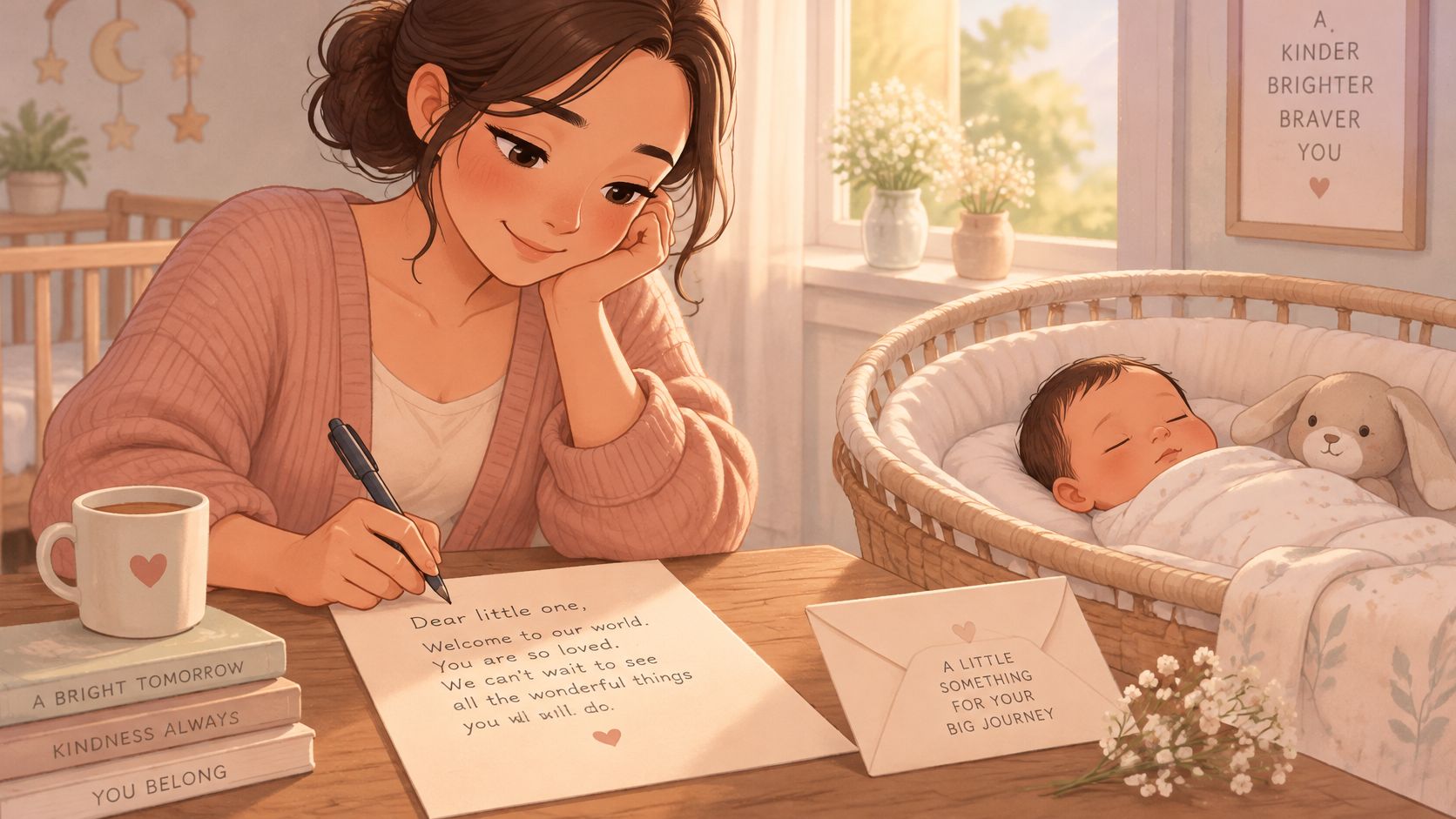
Address the baby directly. Writing to the child, rather than announcing them to everyone else, changes the message. You're leaving something they can read later, not producing a polished account of the birth.
Begin with an ordinary detail: the rain against the window, the blanket tucked around their feet, or their sibling asking when they could meet. Add the names of the people thinking of them, then finish with a hope that leaves room for the child to become themselves.
Write while the details feel close
A parent might draft the letter in their phone while the baby sleeps, then copy it onto paper after coming home. Finish the rough version during an early quiet moment, but don't make beautiful handwriting a condition of completion.
Include the date, where you're writing, and your relationship to the child. For help shaping the message, use this guide to a letter to a child.
- On paper: Use a pen that won't smudge, let the ink dry, and store the letter away from damp and direct sunlight.
- In a digital envelope: Include a clear scan or typed version, with an optional recording of you reading it.
- For the future reader: Explain family nicknames and references instead of assuming the child will recognize them.
Keep medical details private unless the parents want them included. The letter can be honest without becoming a hospital record, and loving without promising a life free from difficulty.
2. Photo Postcard Introduction Series
A distant aunt doesn't necessarily need a long birth update. She may appreciate a photograph of the baby curled against a parent, followed by a short note about the moment.
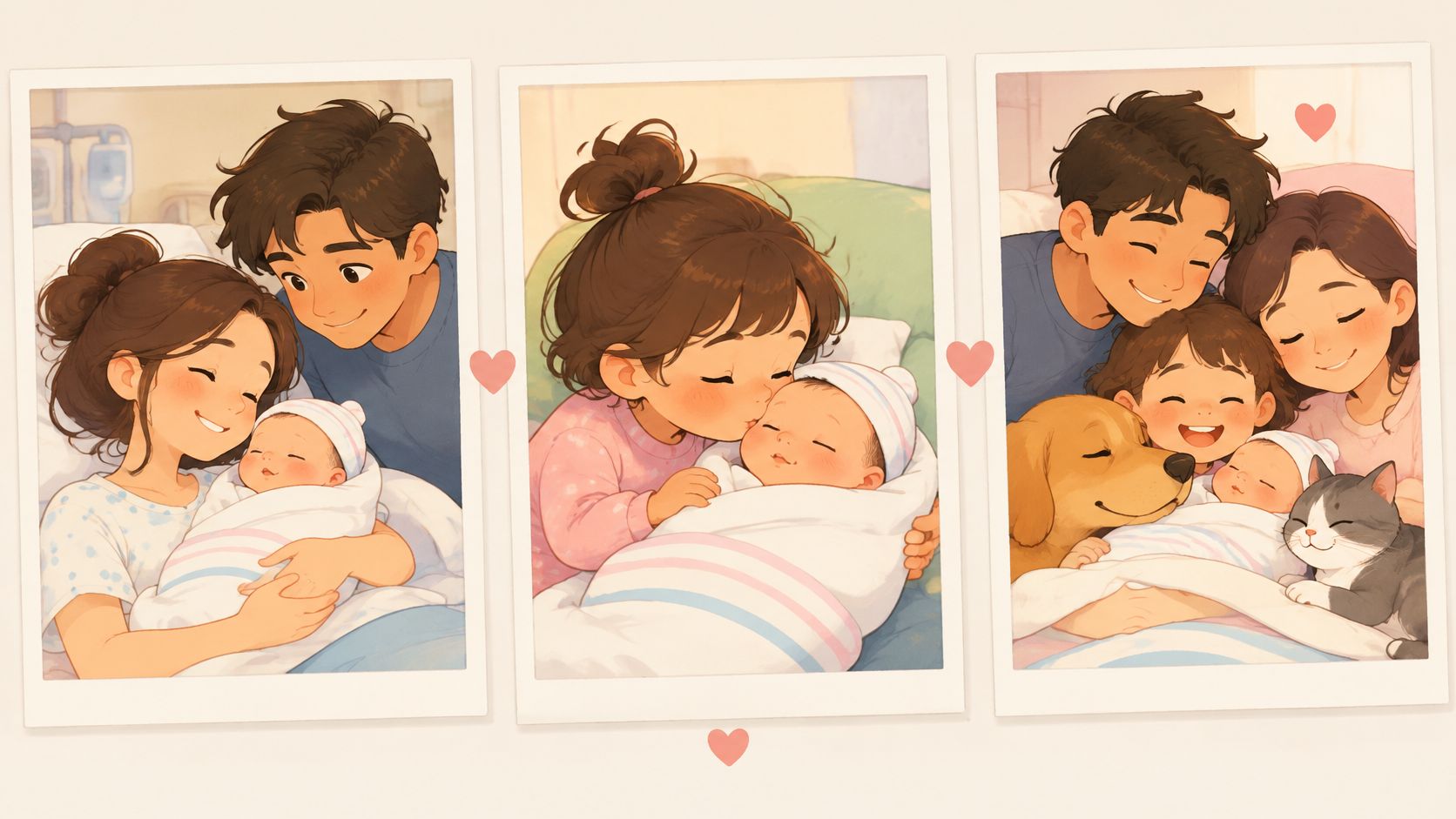
Photo postcards work best as a selected sequence, not a camera-roll export. Choose images that each add something different: an introduction, a family meeting, a quiet moment, and a thank-you to someone who helped.
Send a finished collection, not a daily obligation
Say a family wants to introduce the baby to relatives abroad. They choose photographs of the first cuddle, the siblings meeting, and the baby resting at home, then write a brief message for each recipient.
That's more manageable than promising daily updates. Set your deadline for after the parents have approved the photographs, not for the moment everyone starts asking.
- Lead with the introduction: Put the clearest, most meaningful photograph first.
- Write useful captions: Name the people pictured and describe what's happening.
- Protect private details: Crop out hospital paperwork, wristbands, addresses, and anything the parents don't want shared.
- Include thanks: Acknowledge the person who brought dinner, cared for a pet, or kept checking in.
On paper, write the message on the reverse and arrange the cards before putting them in an envelope. Digitally, pair each photograph with its own postcard message so relatives don't have to match captions to attachments.
Use a birth announcement when the purpose is introducing the baby widely. Keep the more intimate photographs for a smaller, agreed audience.
3. Video Welcome Message from Family
Record people speaking naturally, not performing a perfect greeting. A grandparent's voice or a sibling's delighted interruption can matter more than a smooth edit.
For relatives who couldn't be present, try a simple prompt: introduce yourself, share something you hope to do with the child, and offer a welcome. Record somewhere quiet, face a window for light, and prop the phone securely rather than holding it at arm's length.
Make it usable without sound
A family might collect greetings from grandparents abroad and a sibling at home, then place them alongside a written welcome. Give contributors a clear submission deadline and ask for the original file rather than a screen recording of a forwarded message.
Research on intergenerational digital communication published in JMIR Aging identifies both opportunities for emotional connection and barriers involving navigation, privacy, and confidence. Don't make watching the video the only way to receive the message.
Add captions and a plain-text transcript. Check names carefully if you use automatic captioning, and describe meaningful actions that aren't obvious from the audio.
A relative should still receive the welcome if they can't hear the recording, stream it reliably, or work out the playback controls.
For the paper version, print the spoken message with a photograph of the speaker. In a digital envelope, place the written introduction before the video so recipients know who's speaking.
Watch the finished file before sending. Check the sound, remove accidental private details, and stop editing once the greeting is clear.
4. Grandparent Welcome Letter
A grandparent's letter can give a child something a family tree can't: the small details behind the names. The kitchen where everyone gathered, a phrase used at bedtime, or the reason a family kept a particular tradition can make relatives feel like people rather than entries in a record.
Choose a story, not an entire family history. A grandmother might describe arriving in a new country and the neighbor who helped her settle. A grandfather might explain why he still makes the same breakfast on special mornings.
Connect the past to the child
Move from the memory to a personal hope. A story about neighbors sharing food could end with a wish that the child finds people who make them feel welcome.
Avoid turning family values into instructions about who the baby must become. The message should offer roots without assigning a career, faith, personality, or duty.
- Confirm details: Check names, spellings, and remembered events with another relative when possible.
- Identify photographs: Label who appears, where they are, and how they're related to the baby.
- Keep the speaker's voice: Help with typing if needed, but retain their familiar expressions.
Ask for the letter when the grandparent has space to think, rather than requesting it during a busy hospital visit. A dictated message is just as valid as a handwritten one.
On paper, tuck a labeled photograph beside the letter. For a digital envelope, include the text and an optional reading in the grandparent's own voice. Keep an independent copy with the family's photographs so the welcome doesn't depend on finding an old message thread.
5. Sibling Welcome Note
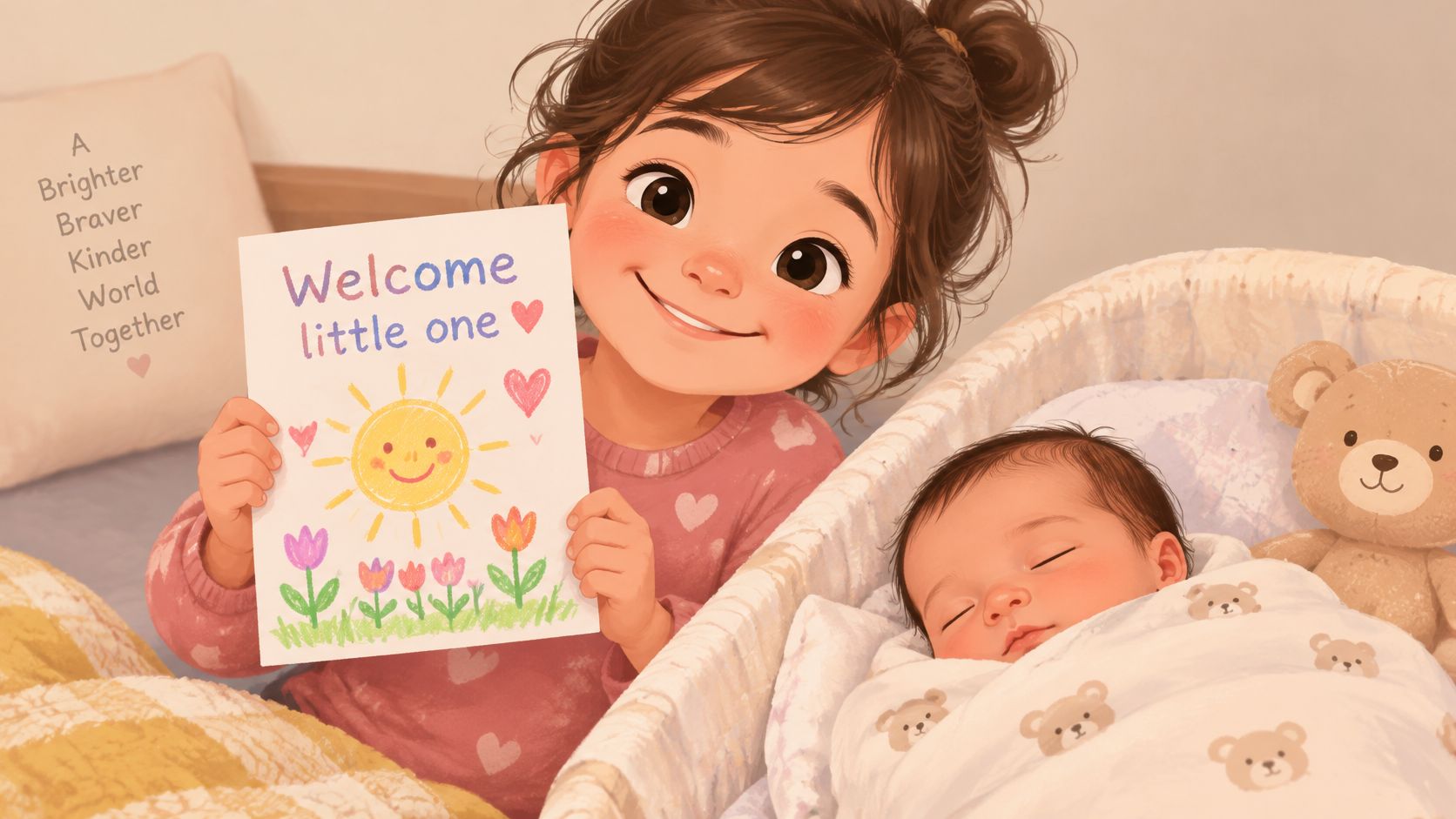
The drawing may show the baby larger than the house. The message may focus entirely on the toys they aren't allowed to touch. Let the older child's welcome sound like the older child.
Offer paper, crayons, or stickers and ask what they'd like the baby to know. If writing is difficult, take dictation and read it back without improving every sentence.
Invite participation without requiring excitement
An older sibling might draw the family dog and explain where it sleeps. Another might describe the books they want to share when the baby is bigger. Both are more personal than a grown-up-written promise to be the best sibling ever.
Mixed feelings don't need correcting inside the note. Don't ask a child to promise constant affection, share all their belongings, or help care for the baby.
- Give a choice: Ask whether they'd prefer to draw, speak, write, or leave it for another day.
- Preserve their contribution: Add their name, age, and the date without covering the original artwork.
- Finish together: Let them choose the envelope or decide which photograph accompanies the message.
Make this a short activity when the child wants attention, not an assignment during an unsettled moment. If they stop halfway through, the unfinished picture can still be kept.
Place the original in the baby's keepsake box. For digital delivery, photograph it in even light, crop out the surrounding table, and include a typed transcription if the handwriting is hard to read. Ask before sharing a recording of the child with a wider audience.
6. Time-Sealed Letter for a Future Milestone
A future-opening letter needs a delivery plan as much as it needs good words. Writing it is only part of the project. Someone must know where it's stored, when it should be opened, and how the child will receive it.
Choose a milestone that fits the message: a birthday, starting school, or leaving home. Then describe the present rather than trying to predict the child's future personality.
Give the future reader something concrete
A parent could write about the view from the hospital window, the music playing at home, and the relatives waiting to meet the baby. Finish with reassurance that doesn't depend on achievement, appearance, or following a particular path.
This time-capsule letter to a child guide can help shape a message intended for later reading. Write a rough version while the arrival still feels recent, then choose the opening occasion once you've had time to think.
Plan for delivery: A meaningful letter can't help its future reader if nobody remembers that it exists.
For paper, mark the intended opening occasion clearly on the envelope and store it with important family keepsakes. Tell a trusted relative where it is, and save a digital copy separately.
For digital delivery, distinguish between a message sent now with future-opening instructions and a service that supports scheduled access. Check the settings before relying on them, especially the recipient's time zone.
Don't treat any delivery service as the sole archive for a long-term keepsake. Retain the original text and photographs somewhere the family can retrieve independently.
7. Blessing or Prayer for the Newborn
A blessing can express hope without trying to explain what a child's life will hold. It might come from a religious tradition, a cultural practice, or the family's own words.
Ask the parents what belongs in their welcome. A prayer that comforts the sender may not reflect the household receiving it. For a mixed-faith or nonreligious family, a personal wish for kindness, companionship, and care may fit better than an unfamiliar religious text.
Offer hope without making promises
Newborn welcomes sometimes arrive during frightening circumstances. UNICEF's newborn-care estimates indicate that 2.3 million children died during their first month in 2022, a reminder not to assume every family is experiencing an uncomplicated celebration.
For a baby receiving intensive care, offer love and presence rather than certainty about recovery. Avoid describing illness as a test, promising that prayer will produce a particular outcome, or asking parents to reassure everyone else.
Welcome the child as they are. Let the parents decide how much of their circumstances to share.
For example, a relative could write a wish that the baby is surrounded by gentle care and that the parents have support nearby. If the family is bereaved, ask whether they would welcome a remembrance message instead of a conventional congratulations card.
Print the blessing beside an approved photograph, or include it as a letter in a digital envelope. If using a traditional text, check its wording and attribution before copying it.
Where translation is needed, include the meaning in language the recipient understands. Offer to send or read the blessing when the family wants it, without expecting an immediate response.
8. Full Family Welcome Envelope
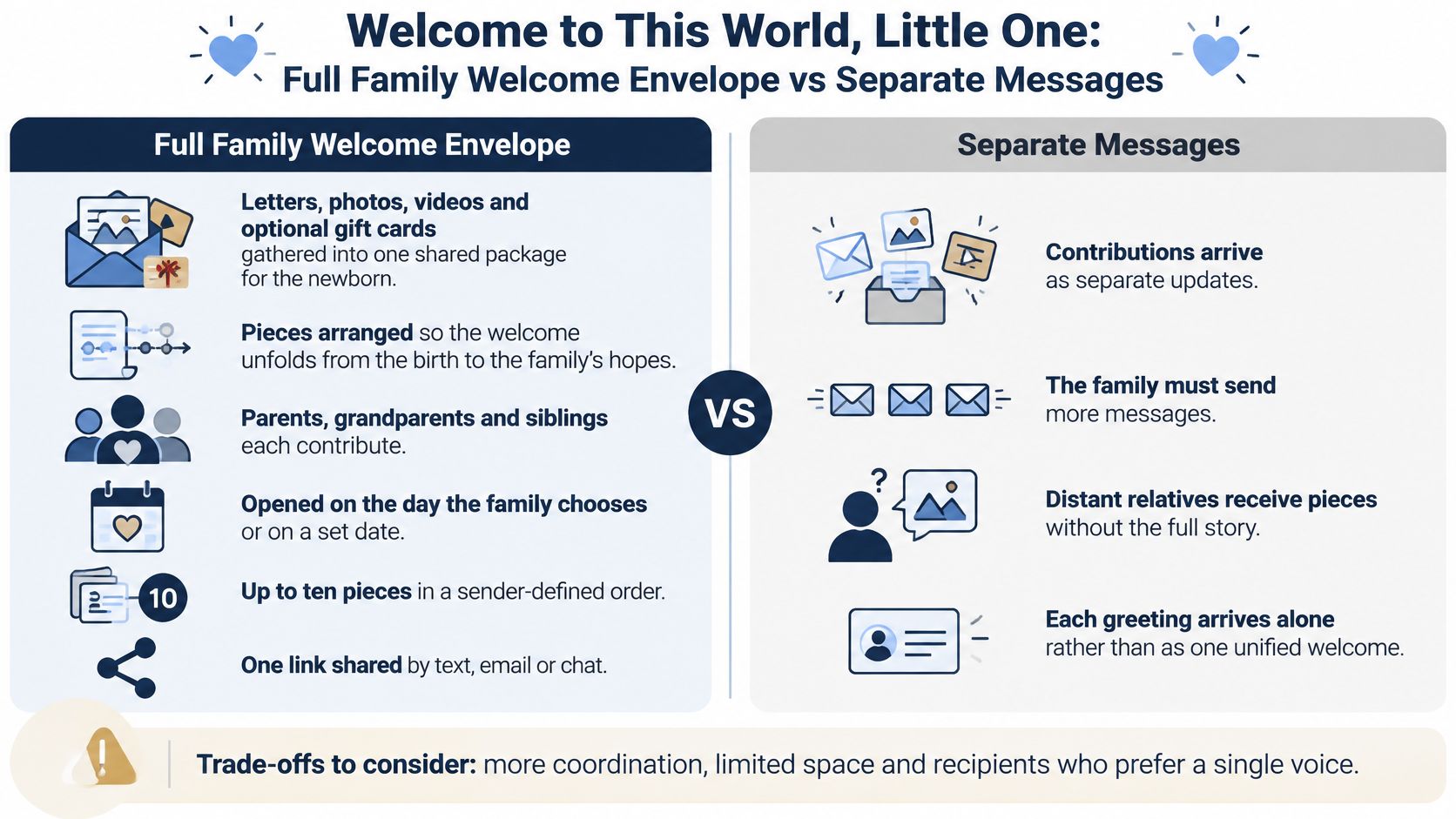
Choose a combined envelope when several people want to contribute but nobody needs another sprawling group chat. Appoint a coordinator who isn't already overwhelmed, and give everyone a small, specific request.
A relative might collect a grandparent's letter, a sibling's drawing, photographs, and a recorded welcome. Ask contributors to send their finished material privately by an agreed deadline so the parents don't have to chase missing files.
Edit for the recipient
A grandparent abroad may appreciate labeled family photographs and a readable letter. Friends who sent gifts may need a warm thank-you and a brief update, not the family's private birth story.
- Set the order: Begin with the introduction, follow with personal contributions, and finish with the shared welcome.
- Check permissions: Confirm which photographs and recordings may be included or forwarded.
- Preview the package: Check names, image orientation, readable text, and video sound before sending.
- Keep gifts secondary: If including a separately purchased gift card, preserve its redemption instructions and keep the personal message prominent.
On paper, use labeled sleeves or folded cards so photographs don't become separated from their messages. Digitally, arrange the contents deliberately and test the recipient's experience on a phone.
The trade-off is coordination. A combined package feels considered, but waiting for every contribution can delay it indefinitely. Send the agreed selection when it's ready; a late relative can still make their own welcome.
Keep a family archive of the original contributions. The envelope is the presentation, not a substitute for keeping the files.
Eight ways to welcome a newborn at a glance
| Item | Best for | Format | Who writes it | Effort |
|---|---|---|---|---|
| Handwritten Welcome Letter to the Newborn | A personal, lasting record of the birth | Handwritten letter | Parents | Low; can be revised over time |
| Photo Postcard Introduction Series | Sharing the newborn's early days in sequence | Photo postcards with short messages | Parents and optionally older children | Moderate; requires choosing and ordering photos |
| Video Welcome Message from Family | A warm greeting for family separated by distance | Short video message | Parents, siblings, or grandparents | Moderate; requires recording and possibly editing |
| Grandparent Welcome Letter | Connecting the newborn to family history | Letter, optionally with photos or a family tree | Grandparents | Low to moderate; stories and details may need checking |
| Sibling Welcome Note | Including older children and recording their perspective | Short note with an optional drawing | Older sibling, with help if needed | Low; may need adult assistance |
| Time-Sealed Letter for a Future Milestone | Sending a welcome for a meaningful future moment | Sealed letter for a chosen date | Parents or another family member | Low to moderate; requires safe storage and a reminder |
| Blessing or Prayer for the Newborn | Marking the birth with a spiritual or cultural welcome | Short written or spoken blessing | Parents or family members | Low; can be personalized |
| Full Family Welcome Envelope | Bringing many people's contributions together in one welcome | Collection of letters, photos, videos, and optional gift cards | Parents, relatives, and friends | High; coordinating contributors takes planning |
Write One Welcome That Lasts
Choose the welcome you can complete without borrowing energy the family doesn't have. A handwritten paragraph is enough if it contains something personal. A larger collection makes sense when someone has the time to organize it and the parents want it.
Start during the first week if circumstances allow, while small details are easy to recall. That's a useful creative deadline, not a test of affection. If the birth has been difficult or the household needs privacy, write your draft privately and let the family decide when to receive it.
Match the message to its reader
A welcome addressed to the baby can be intimate and reflective. A message for parents should acknowledge them without requiring an update. A package for distant relatives should explain who's pictured and provide a straightforward way to open the contents.
Before sending, make these decisions:
- Choose the audience: Decide whether this is for the child, the parents, close relatives, or a wider circle.
- Choose the timing: Send now, wait for permission, or save the message for a future milestone.
- Choose the keeper: Make sure someone knows where the original letter or files will live.
A digital envelope can carry a letter, photographs, and recorded voices to relatives who couldn't be there. Paper offers something tangible to place in a baby book. Neither format makes the words more loving, and using both doesn't require creating different messages from scratch.
Keep the finished welcome separate from official documents. A keepsake celebrates identity, but it doesn't establish it legally: UNICEF's birth-registration guidance explains why registering a birth matters for a child's recognized legal identity and access to services. Don't include certificates or other sensitive documents in a family greeting.
Write Welcome to this world, little one, then tell the child something true: who was waiting, what someone noticed, or what you hope to share. Avoid assigning them a future they haven't chosen.
The best welcome isn't the longest, most polished, or most widely shared. It's the one the family can keep safely and the child can still read years later.
Stampgoose offers browser-based digital envelopes for letters, photo postcards, videos, and gift cards purchased elsewhere, shared through a single link without a recipient app or account. Visit Stampgoose to gather your newborn welcome into an envelope, preview the contents, and share it with the relatives you want to include.