What to write in an Elf on the Shelf arrival letter
The elf turns up on the first of December with a letter, and the letter does the work: who it is, why it is here, and the one rule. Here is how to write one, for a first year and for an elf coming back.
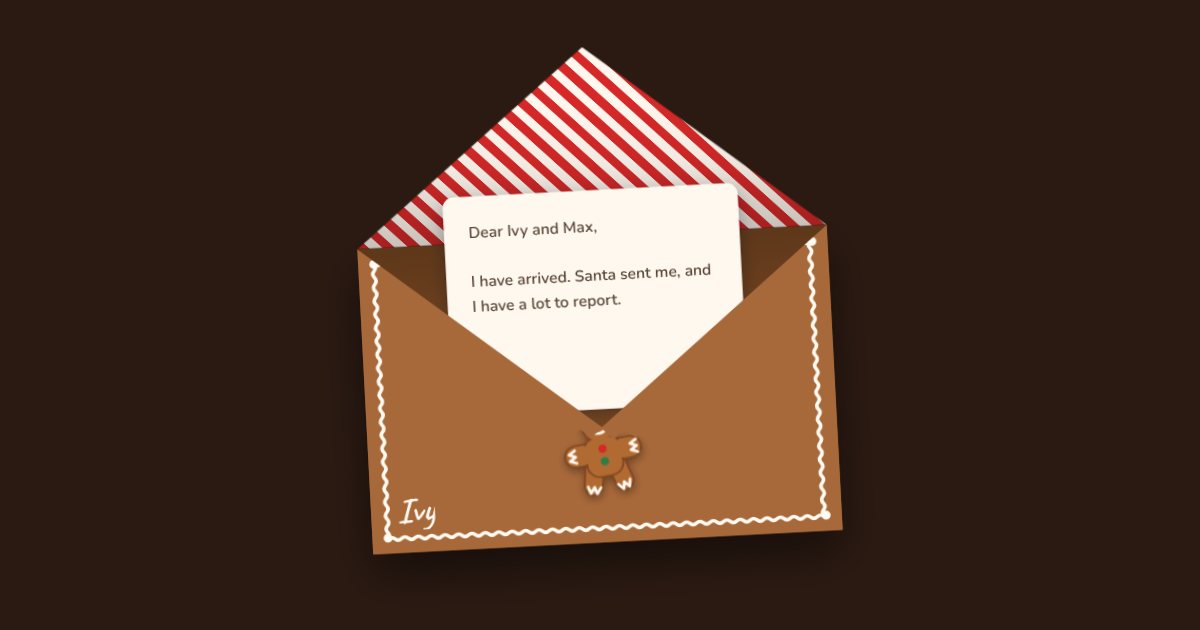
An Elf on the Shelf arrival letter is the note the elf brings when it turns up at the start of December: who it is, why Santa sent it, and the one rule about not touching it. The letter does more work than the elf does. Get it right on the first morning and the next twenty-four look after themselves. Here is what to put in, for a first-year elf and for one that is coming back, with lines to borrow and a whole letter at the end.
What the arrival letter has to do
Four jobs, in this order. Everything else is decoration.
- Say who it is. A name, and that Santa sent it. The children will want to name it themselves; the letter can leave the name blank, or the elf can arrive with one and a story about how it got it.
- Say why it is here. To watch for kindness and report back to Santa each night. Kindness, not behaviour: an elf that watches for kindness gives you something to praise every morning.
- Give the one rule. No touching, or the magic fades and the elf cannot fly. Keep it to one rule. More than one and you are writing terms and conditions.
- Set the pattern. It flies to the North Pole every night and is found somewhere new every morning. Say so, and the children will go looking before you are up.
Lines for a first year
A first arrival letter explains the whole thing. Short sentences, one idea each; it will be read aloud at seven in the morning.
Dear Ivy and Max, I have arrived. Santa sent me, and I have a lot to report.
My name is Pip. I will be sitting somewhere in your house every day until Christmas Eve, watching for kindness, which is what Santa most wants to hear about.
Every night I fly back to the North Pole to tell him. Every morning you will find me somewhere new. Sometimes I get a bit lost.
There is one rule: please do not touch me, or my magic fades and I cannot fly. Talking to me is fine. I am a good listener.
I do not have a name yet. Santa said you would think of one. Write it on a piece of paper and leave it by my shelf tonight.
Lines for an elf coming back
A returning elf does not need the rules again. It needs to remember things, which is what makes it real. Jot down three details from the past year before you write.
I am back. I have missed this shelf, and I have missed you two. The North Pole is lovely but nobody there does the funny dance before tea.
I heard about the new baby. Santa was delighted. I am slightly worried about the baby’s reach, so I may sit higher up this year.
Last year you built me a sofa out of a tissue box. Santa has one now. He asked for the plans.
I have been told you learnt to swim, lost two teeth and moved up a year at school. The elves and I had a small party about it.
Setting expectations, kindly
The arrival letter is also where you decide how much work December is going to be. An elf that gets up to mischief every night is twenty-four nights of ideas. An elf that mostly watches is a shelf and a letter. The children will accept whichever the letter says.
I am a quiet sort of elf. I mostly sit and watch, and I like to be found. Some elves make a mess. I think that is rude in someone else’s house.
Some mornings I will have been busy in the night. Some mornings I will have had an early night. Both are allowed.
Things to leave out
- Threats. The elf reports kindness, not naughtiness. “Santa is watching” has never improved a December.
- Promises about presents. The elf does not know what is coming and should say so if asked.
- A long letter. Eight short lines beats two long paragraphs. The whole letter below is about 120 words, and that is plenty.
- Your handwriting. If you are writing it by hand, use a pen the children have not seen. If it is on a screen, choose a type you never use.
A whole letter, to borrow from
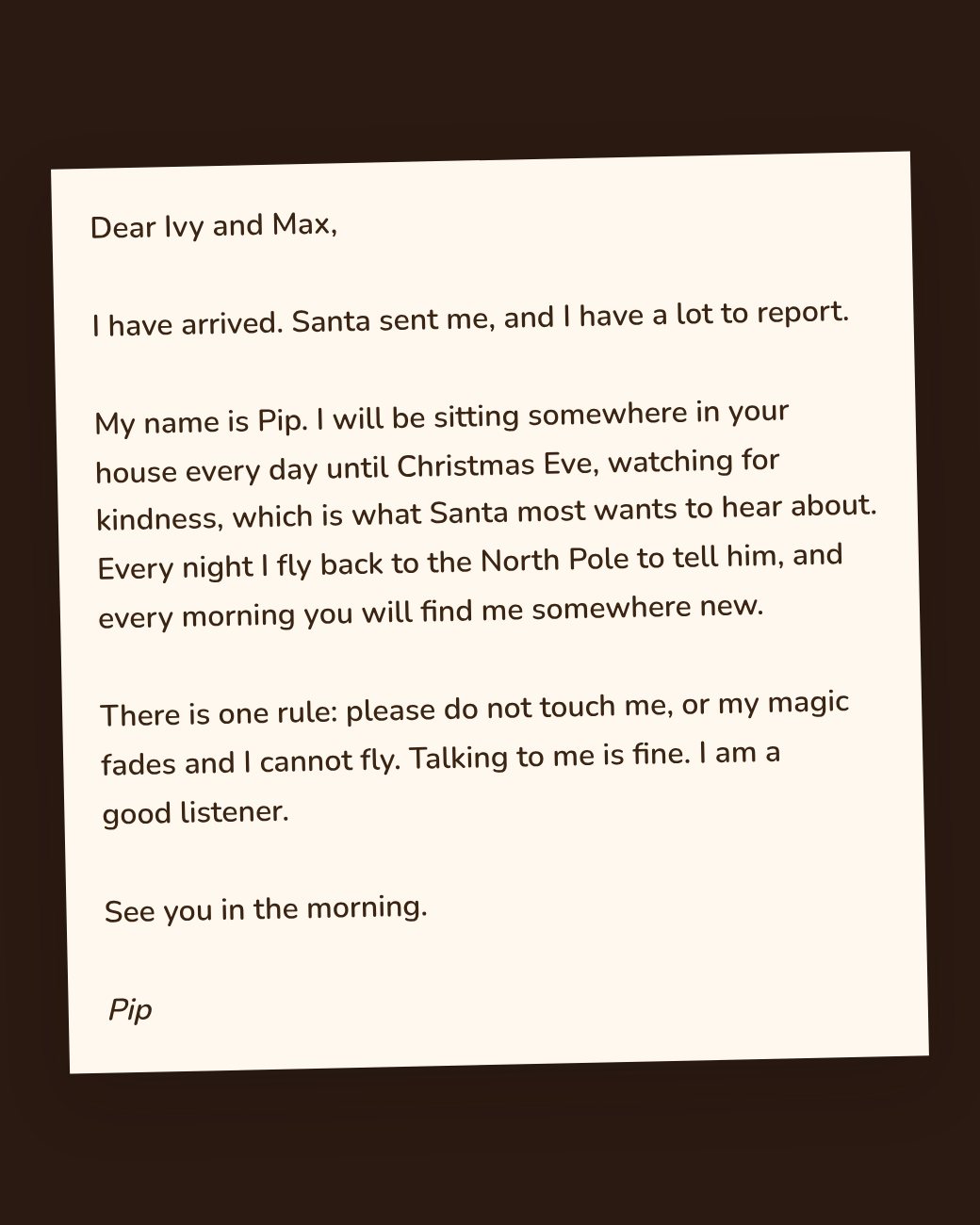
Dear Ivy and Max, I have arrived. Santa sent me, and I have a lot to report. My name is Pip. I will be sitting somewhere in your house every day until Christmas Eve, watching for kindness, which is what Santa most wants to hear about. Every night I fly back to the North Pole to tell him, and every morning you will find me somewhere new. There is one rule: please do not touch me, or my magic fades and I cannot fly. Talking to me is fine. I am a good listener. See you in the morning. Pip.
Sending it as an envelope
If the elf is on the shelf but the printer is out of ink, or the elf is arriving at a grandparent’s house, the letter can arrive on a screen. Write it as the elf on the letter from Santa page, which has the Nice List envelope, put the children’s names on the front and the elf as who it is from, and set it to open at seven on the first of December. It shows a sealed envelope and a countdown until then, which is its own kind of arrival. The Christmas page has the rest of the season, and the video message page covers a hello from the North Pole, if someone in the house does a good elf voice.
Questions people ask
When does the elf arrive?
Most families bring the elf out on the first of December, or the first day of Advent, and it stays until Christmas Eve, when it goes back to the North Pole with Santa. Some wait for the first weekend in December so the first morning is not a school morning.
What should an arrival letter say?
Who the elf is, that Santa sent it, the one rule (no touching, or the magic fades), and that it flies back each night to report. For a first year, how it works; for a returning elf, what it remembers from last year.
Does the elf have to get up to mischief every night?
No. The letter can say the elf is a quiet one that mostly watches, which saves twenty-four nights of ideas. If the children ask, the elf is keeping a low profile this year.
Can I send the letter instead of printing it?
Yes. Write it as the elf, put the children’s names on the envelope, set it to open at seven on the first of December, and send the link to the family tablet. The elf is on the shelf; the letter is on the screen.
Not sending one today?
We’ll remind you before Diwali and Christmas: a few emails a year, a week or so before the days people send envelopes for. Nothing else, and one click stops them.